 Somerled
Blinky v1.1A — Two-Transistor Learning Kit
$9.95
Solder your first circuit in an evening and finally understand how a transistor works. Two LED eyes blink back and forth, all by themselves.
The best first kit you’ll ever build
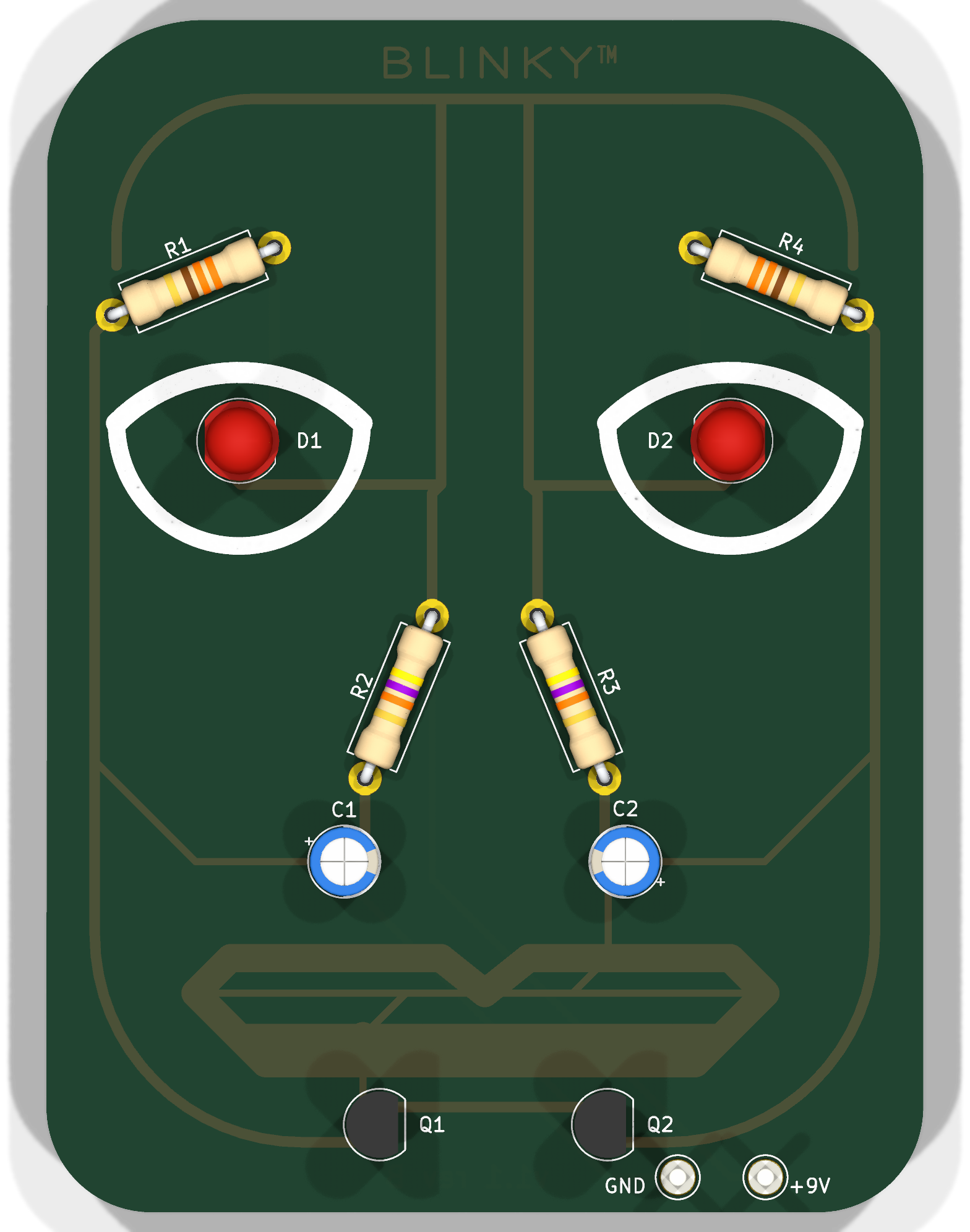
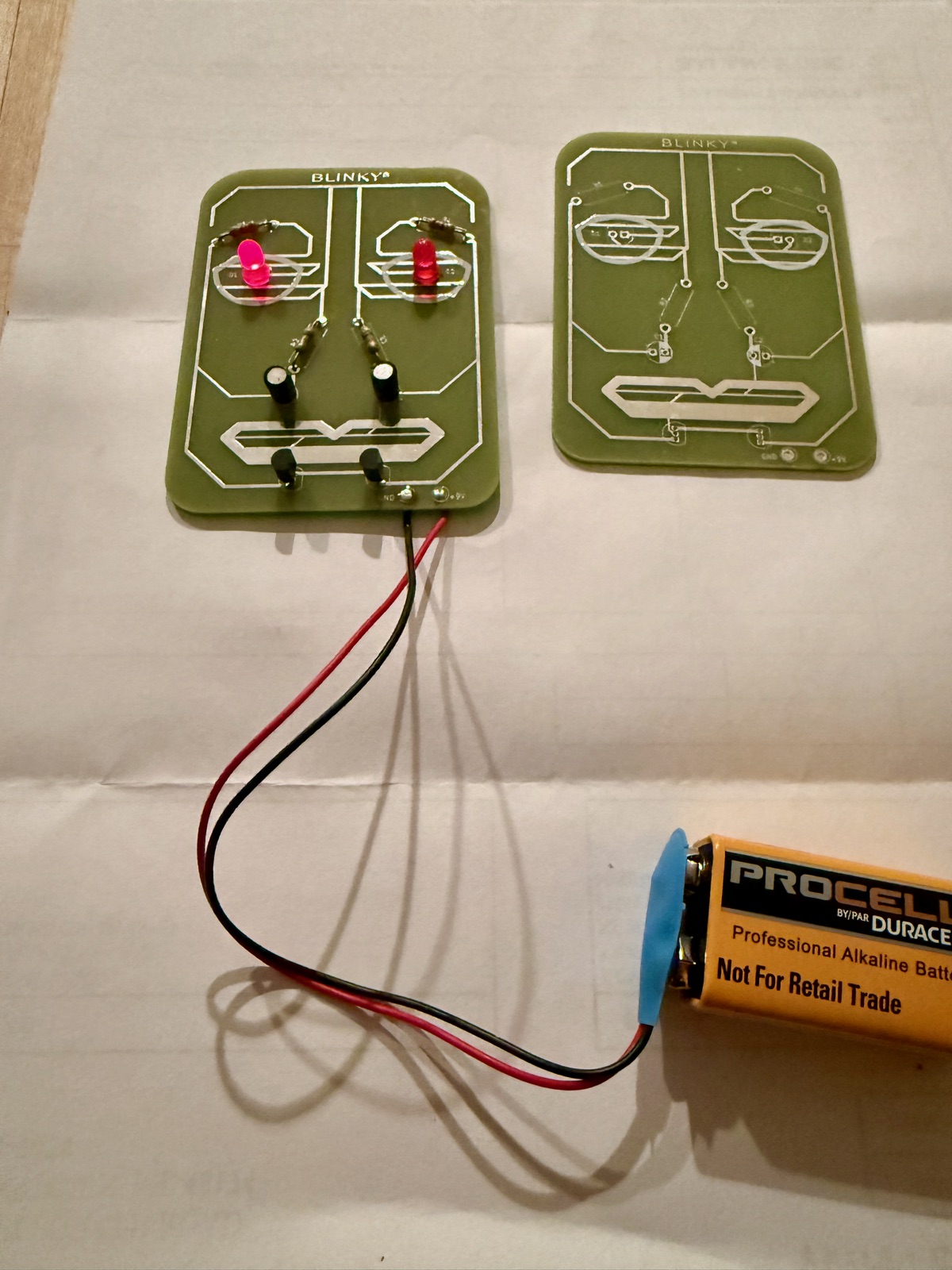
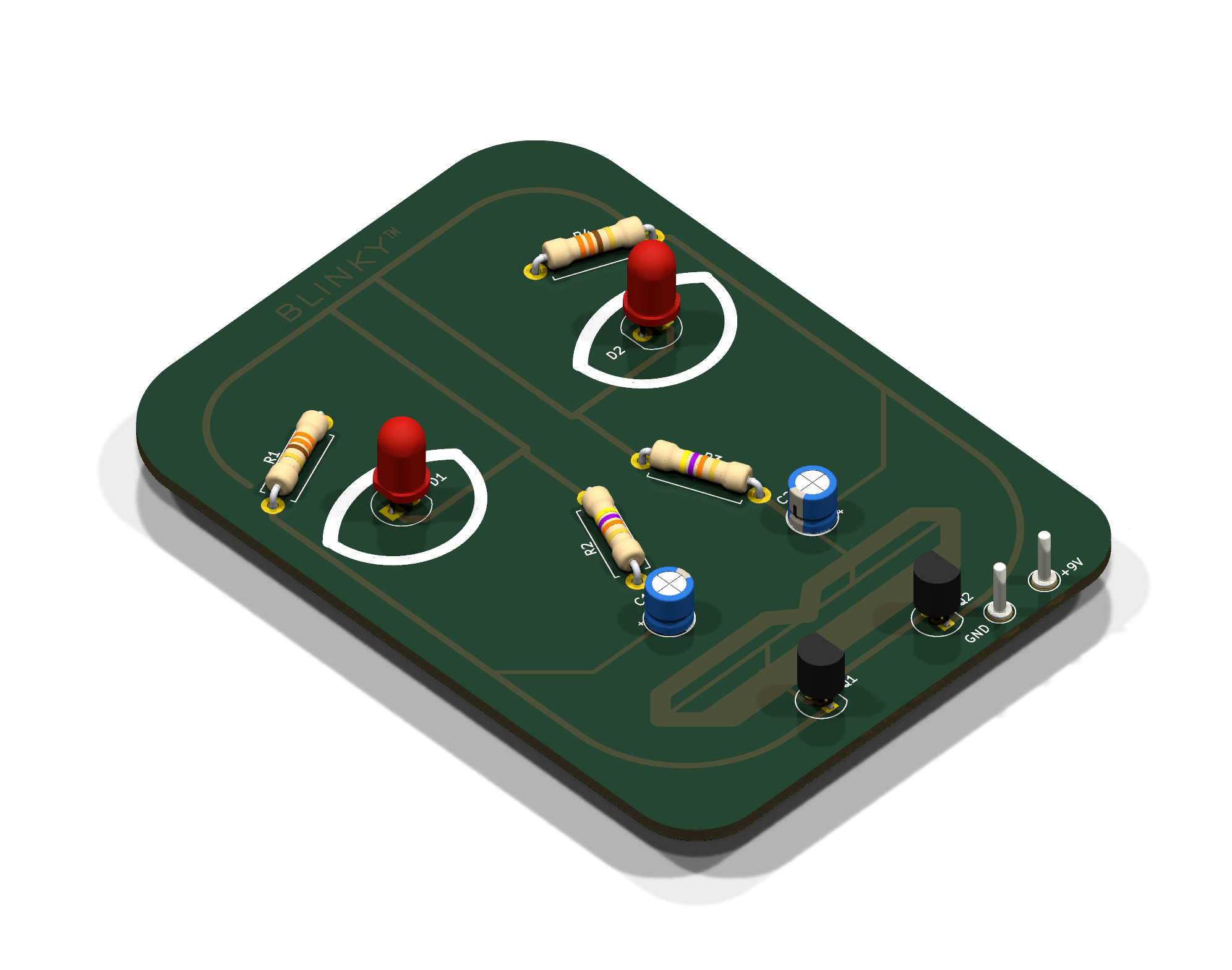
Blinky is a little circuit-board face whose two LED eyes take turns blinking — left, right, left, right — for as long as the battery lasts. You’ll build it in an evening or less, and along the way you’ll learn how a transistor works, the most important idea in all of modern electronics.
It’s a classic two-transistor astable multivibrator — the same circuit the designer, Kevin (W8VOS), built in 1983 at Basic Electronics Tech school at Keesler Air Force Base. Understand Blinky and you understand the transistor as a switch.
What you’ll learn
- Soldering, properly. Step-by-step method, what a good joint looks like, and how to fix the common faults.
- Components. Resistors and colour codes, electrolytic capacitors, LEDs (anode vs. cathode), and NPN transistors and their pinouts.
- How it actually works. A short course in transistors — vacuum tubes, Bell Labs 1947, doping, PN junctions, NPN vs. PNP — then exactly why each eye stays lit for about 0.72 s (0.693 × 47 kΩ × 22 µF).
- Think like a technician. The rev A board’s LED silkscreen is printed reversed, and the manual turns that into a lesson: “Don’t trust the silkscreen: check with the schematic.” You’ll prove the correct LED direction yourself from the schematic and the copper, a habit that pays off in every kit after this one.
- Troubleshooting and experiments to go further once it blinks.
Classic-style manual: every step has a check box, so you always know where you left off.
What’s in the box
- Blinky circuit board, v1.1 rev A, 2.500 × 3.400 in (63.5 × 86.4 mm)
- 2 × 330 Ω resistors (R1, R4)
- 2 × 47K resistors (R2, R3)
- 2 × 5 mm LEDs, matched pair (D1, D2). LED colour may vary.
- 2 × 22 µF electrolytic capacitors (C1, C2)
- 2 × small-signal NPN transistors, matched pair (BC548, 2N3904, PN2222 or similar)
- 9 V battery snap
9 V battery not included. LED colour may vary. There’s no power switch — unsnap the battery to turn it off.
At a glance
| Availability | 10 kits ready to ship |
| Skill level | Beginner — first-kit friendly |
| Build time | An evening or less |
| Solder joints | 24 |
| Power | One 9 V battery (not included) |
| Blink rate | ~0.72 s per eye, ~1.4 s full cycle |
What you’ll need
Soldering iron (25–40 W, or a station at ~650–700 °F), rosin-core solder, iron stand and tip cleaner, diagonal cutters, long-nose pliers, a multimeter (for the LED check and experiments), safety glasses, and good light. Desoldering braid is handy.
Manuals
Buy securely
Use Buy now (or Add to cart). Payment happens on Stripe’s hosted Checkout page. No card data is collected or stored on our server.
Board & product views